The Bride With White Hair (1993) |
|
 |
Directed
by: Ronny Yu Buy
the DVD at: |
| Awards
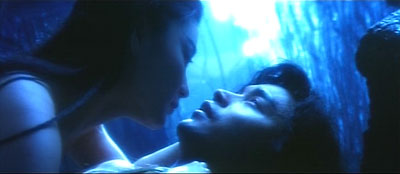
at the Hong Kong Film Awards 1994: Best Cinematography (Peter Pau) Best Art Direction (Eddie Ma) Best Costume Design (Emi Wada & Cheung San-Yiu) Nominations at the Hong Kong Film Awards 1993: Best Editing (David Wu) Best Original Film Score (Richard Yuen) Best Original Film Song Hung ngaan baak faat (Red Face, White Hair) Music: Leslie Cheung Lyrics: Lam Jik Performed by: Leslie Cheung Awards at the Taiwan Golden Horse Awards 1993: Best screenplay adapted from another source (Ronny Yu, David Wu, Lam Kei To & Tseng Pik-Yin) Best Original Song This period fantasy/horror/romance epic was the start of a very successful collaboration between director Ronny Yu and cinematographer Peter Pau. Of equal importance was also the joining of veteran editor David Wu and art director/production designer Eddie Ma. It resulted in multiple awards and these key people again teaming up for The Phantom Lover. The Bride With White Hair subsequently got the attention of international audiences and led to Ronny Yu now making movies in Hollywood. Whether that's a good thing or not I let each reader decide for themselves... Ching Emperor Shin Tsu have fallen ill and he dispatches men to obtain a rare flower that can revive the dead or dying. At the Shin Fung mountain where the flower is located, there also is a swordsman guarding it, Master Cho (Leslie Cheung). He refuses to let the flower into the hands of the emperor's men and slays them all. That leads us into a flashback that tells the story of the forbidden love between him and Wolf Girl (Brigitte Lin). A love between two people destined to be enemies, set during the escalating battle between opposing clans and supernatural evil...
Up till this point in his career, Ronny had directed in a number of genres but it was with this breathtaking 1993 production that he really came into his own as a director capable of delivering something of epic proportions (and match Tsui Hark in the visuals department). Based on the Wuxia novel by Leung Yu-Sang, that isn't a fact that should make you skip this one if you're familiar with what Chu Yuan did with Gu Long's Wuxia novels at Shaw Brother's. They often included numerous characters and headache inducing plot twists but that's being faithful to the material. This adaptation skips those aspects but keeps the staple story element about rival clans. There's certainly a fair amount of names to keep track of but when it comes to down to it, this adaptation is very easy to follow. Just like my review of The Phantom Lover, we're going to focus on the filmmaking team around Ronny first, starting with cinematographer Peter Pau. Much has been said about Peter's superb skills in the field of cinematography and it's enough to say that what his eye captures is so much of what makes The Bride With White Hair a success. Clearly on a slightly limited budget, the scope ranges from restricted at first to some of the grandest you will ever see in a Hong Kong movie of this era. After Once Upon A Time In China came out in 1991, there was a rebirth of martial arts cinema but also period productions were becoming more common again. That had both its pros and cons but this production genuinely has the effort in it to justify the excess. Peter beautifully captures Eddie Ma's design work that isn't able to be shown in constant big, epic shots but even within a tighter frame there's a lot of detail to absorb. As I said, the budget dictated this to a degree but there exists simple solutions in here that registers as something bigger on film (the water fall set being a marvelous example of this). The movie switches gears in a big way during the second half and saves a lot of the best intentions to last. The finale is really where the money shows up on screen and you have to remember that Hong Kong cinema wasn't spoilt with big movies like this, in terms of cinematography, art direction and production design, at this time.
If there's one flaw in The Bride With White Hair it is the fact that it does get off to a slow start. Intentional perhaps but why complain when Ronny throws so much creativity and confidence up on the screen? Yes, the story elements are, at the core, basic but it's still a unique film of this era, much thanks to the pairing of Leslie Cheung and Brigitte Lin. There needs to be believability projected through acting as well as surrounding events and while there's no one big spoken reason for the attraction between these two, it works in its simplicity even better. Having actors like Leslie and Brigitte further cements the number one thing The Bride With White Hair needed to get right. The movie's era, set at the end of the Ming dynasty with not only Manchurian forces roaming the country but also supernatural evil, is nothing short of astonishing in its portrayal. It's a world filled with darkness and very few light touches. That's another thing, Ronny and his team of screenwriters rightly chooses not to go for extensive comic relief (comedy can find a way into any Hong Kong movie, believe me). If it's there, it's for the story that also has an element of youthful innocence. While dark, the positivity resides between Leslie and Brigitte's characters, the souls who wants to break free of traditions and try and find their peaceful place in this world. It does become evident though that Ronny, after introducing the threat of the Manchu's, completely forgets about them. When looking back at it, choosing not to feature them prominently isn't a problem because an establishment of what other evil is out there is still effective. It just seems, during viewing, that their presence should've been felt more.
The action choreography by Phillip Kwok (Mad Dog from Hard Boiled and one of the Venom's) shows him not being very interested in throwing fight after fight at the viewer. The ones that are in there are staged in tune with the epic nature of the film but by employing step printing (creating a slow and grainy look), the fights never really makes an impact. What Phillip does provide is a big amount of wire-work showing characters, since this is a Wuxia adaptation after all, flying and performing physical feats out of this world. It's executed with a great sense of fluidity that isn't up there with the best of them but certainly a big part of the impact the movie has. Going back to the step printing, it celebrates triumphs when used for dramatic moments. The way it's slow but not slow motion definitely is absorbing when combined with the storytelling. Leslie Cheung sadly committed suicide on April 1st 2003 and left behind him an impressive body of work, both in acting and singing. The always youthful Leslie made sure classics like A Better Tomorrow and A Chinese Ghost Story are not only remembered for their movie quality but for having striking theme songs to go along with them. When this movie started production he had actually retired from singing but was talked into creating a song for the closing moments of the film. On one condition; that it only would be heard in the film. Good way to lure people into the cinema but it was for an excellent film though. Leslie puts in a strong performance as well as showing a strong sense of belonging to the role of Cho. He's a playful character at first but someone we know is going to grow into a noble man. A noble man that thinks himself and is not willing to sacrifice his honor and pride to become what is expected of him within the clan. He shares similarities that way with Wolf Girl that is played by one of my absolute favourites, Brigitte Lin. It's the ageless beauty, the intense eyes, the sense of genuine tenderness that she in such a mesmerizing way shows when playing this character. You can't take your eyes off her. Few could equal the prowess Brigitte injected into some of her parts and she's always been the one actress that could wear the period outfits most gracefully. Francis Ng and Elaine Lui are our villains, playing male/female Siamese twins. Wonderfully bizarre and Elaine Lui suitably acts over the top as the more decisive of the two while Francis plays the powerful yet weaker twin. It was one of his first big movie roles and it already shows that when he's trying (or even overacting), he's an assured presence. The twin special effect is executed via simple means throughout but the big reveal of the entire naked body is effective work by the effects department. Even border lining on eerie the way that it's shot. Francis also walks away with the best line from the movie, towards the very end.
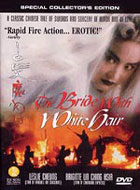
The Bride With White Hair deserves all the accolades it has received over the years and is no doubt a great intro for anyone new to this genre of Hong Kong cinema. Dark, erotic with plenty of classic imagery, this is one you don't want to miss. The DVD: Tai Seng presents the movie in its original 2.35:1 aspect ratio. It does look good but flaws keep popping up that aren't so easy to let go off. Dirt on the print is fairly frequent and is noticeable since it's a very dark movie. Grain is seen at times (not just in the scenes with intentional grain) and while some select shots are sharp, a large number also produces a fuzzy feel to the print. Very watchable but flawed. The Cantonese track was originally mixed in Dolby Pro Logic and the mix is impressively re-created on this disc. Front speakers and surrounds are used very well for the rousing score but sound effects feels a little thinner. It's very enveloping and adds greatly to the atmosphere though and it's a rare treat to hear a 1993 Hong Kong movie presented this well. Mono Mandarin and English tracks are also on the disc. The English subtitles are removable and feels like a solid translation of the dialogue. If not that, then at least it's free of grammar- and spelling errors. The problem is they're way too big to be placed entirely on the image. Should've reduced the font or placed them partly in the black bars, Tai Seng!
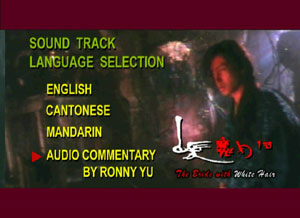
This Special Collector's Edition comes with a few decent extras, main one of interest being the audio commentary by director Ronny Yu. This will test your patience because very early Ronny leaves noticeable gaps of silence between comments. That becomes even worse during the second half. When he does speaks he provides a decent overview of the movie, going over topics such as how they were given permission to add or change things compared to the original novel, the different look of The The Bride With White Hair compared to other movies in the genre, the tight shooting schedule (it was completed in 8 weeks believe it or not) and the reasoning behind the step printing used in the film. Some fun trivia pops up along including the reveal that Leslie's character as a young boy was actually played by a girl and the mistake that led Ronny to employing step printing in not only the action scenes. Have to mention that Ronny's admiration for Brigitte and Leslie does shine through and it's interesting to hear him talk about favoring quiet moments (because of their strong presence) rather than dialogue.
(Ronny Yu and Brigitte Lin interviews from the Making Of) Next is a subtitled 12 minute Making Of featurette. Short interview snippets with main crew, quickly edited shots from the set and plenty of movie clips sadly dominate this piece. Only the short contributions from Peter Pau (program identifies him as Peter Pan) and Eddie Ma ranks as interesting. Clearly a promotional program. Filmography section offers well-written and fairly extensive bio's/filmographies on actors Leslie Cheung, Brigitte Lin, Francis Ng and director Ronny Yu. Obviously a bit dated (disc came out in the latter part of the 90s) but a good read nonetheless. The theatrical trailer for The Bride With White Hair (presented in fullscreen and with Mandarin dubbing) plus Tai Seng's video trailers for The Bride With White Hair 2, The Untold Story, Tai Chi 2 and Organized Crime & Triad Bureau rounds off the disc. reviewed by Kenneth Brorsson
|
|